Civil Blogs
Framework Contract: A Comprehensive Analysis of Effective Procurement

2024-10-16 15:49:14
Share On Social Media :
Framework Contract: A
Comprehensive Analysis of Effective Procurement
Introduction
A Framework Contract
is a strategic agreement established with suppliers, contractors, or service
providers to delineate the terms governing contracts that may be awarded
throughout the duration of the agreement. Often referred to as an
"umbrella agreement," a framework contract outlines the terms and
conditions for specific purchases, particularly focusing on price, quality, and
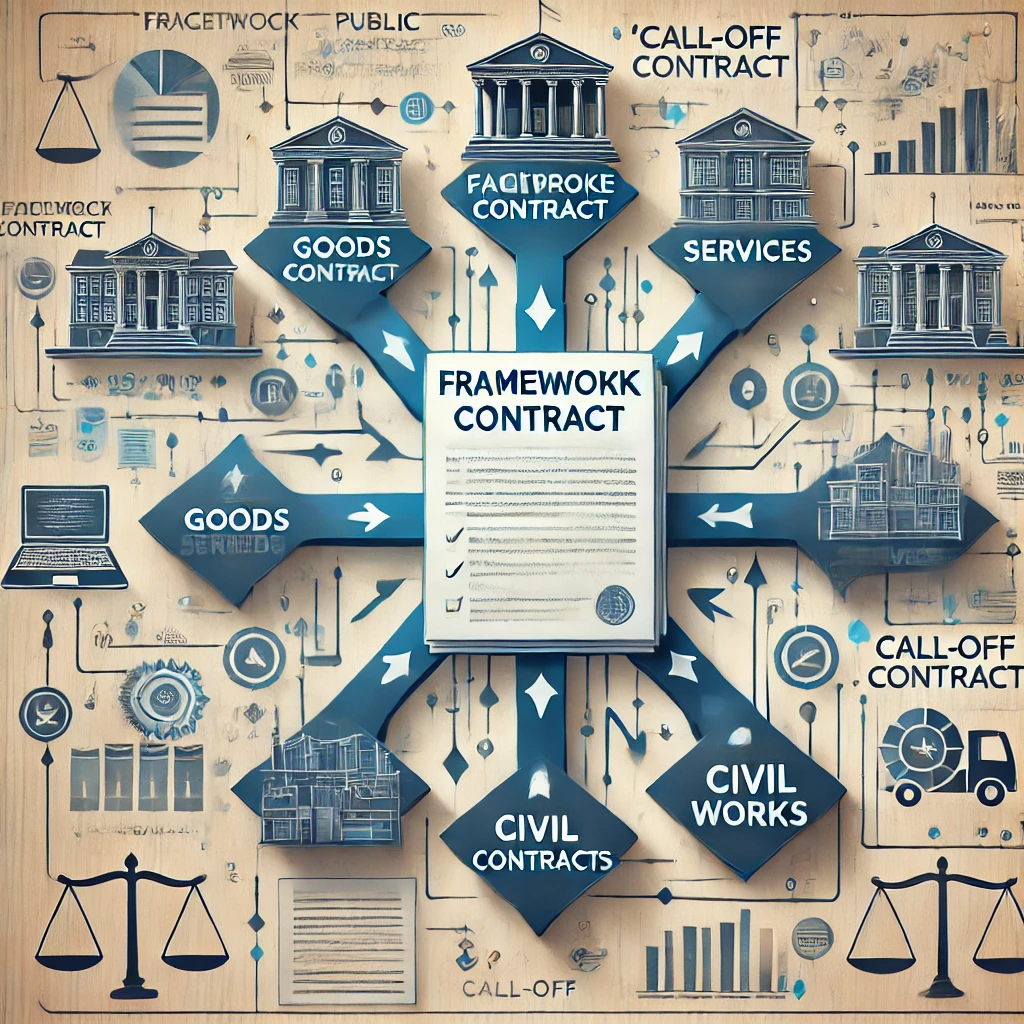
quantity. This setup allows for individual contracts, known as
"call-offs," to be executed over the agreement period, typically
spanning up to five years.
Framework contracts
generally encompass a broad range of goods, works, or services, or a
combination thereof. Common examples include:
- Goods:
Office supplies, furniture, etc.
- Services:
Design consultancy, supervision consultancy, etc.
- Civil Works:
Construction of buildings, bridges, etc.
Conditions for Using
Framework Contracts
While a Framework
Agreement (FA) can function as a binding contract if it creates obligations to
procure and supply, it is more commonly a non-binding arrangement that sets the
terms and conditions applicable to any orders placed during its lifespan. Framework
contracts are particularly advantageous under the following circumstances:
- Uncertain Requirements:
When the exact timing or quantities of future deliveries are unknown at
the time of contract award.
- Stock Maintenance:
To permit the maintenance of minimum stock levels.
- Ongoing Procurement Needs:
When procurement is expected to occur on an indefinite or repeated basis
within a specified period.
- Disaster Management:
For managing logistic supplies during emergencies.
Framework Procedures
Open and Closed
Frameworks
- Open Framework Agreements:
- Allow new suppliers or contractors
to join the agreement at any stage.
- Public entities (PEs) can establish
and maintain open FAs online, fostering competitive bidding.
- Ensure that bidders have equal and
continuous opportunities to present their bids.
- Closed Framework Agreements:
- Restrict participation to the
initially selected suppliers or contractors.
- Procurement contracts under a closed
FA can only be awarded to these initial parties.
- Do not provide continuous bidding
opportunities, potentially limiting competition.
Single and Double Stage
Procedures
- Single Stage:
- Selection and award processes occur
simultaneously.
- Double Stage:
- First Stage:
Selection of suppliers or contractors to be part of the FA.
- Second Stage:
Awarding of specific procurement contracts under the FA.
- With Second Stage Competition:
Certain procurement terms not precisely established during the FA are
refined through a second competition.
- Without Second Stage Competition:
All procurement terms are established at the conclusion of the FA.
Single and Multiple
Supplier Frameworks
- Single-to-Single FA:
- Involves one PE and one supplier or
contractor.
- The PE calls off its requirements
based on pre-agreed terms.
- Multiple Suppliers:
- Covers the needs of multiple PEs
over subsequent years.
- Bids are evaluated for each call-off
based on the most economically advantageous or lowest price criteria.
- Mini-competitions may not be
necessary if terms remain consistent.
Frameworks by Procurement
Area
Framework for Goods and
Supplies
- Diverse Product Coverage:
- Includes various suppliers for
different product categories, such as different types of paper.
- Facilitates supply over extended
periods, e.g., five years.
- Procurement Process:
- Based on financial, economic, and
technical capacity.
- Selection is made on the basis of
the most economically advantageous or lowest price offers.
- Alternatives include single supplier
agreements per region or product to ensure rotation and reliability.
Framework for Consulting
Services
- Range of Services:
- Includes accounting, auditing,
system design, software maintenance, etc.
- Selection and Evaluation:
- Candidates are shortlisted based on
financial, economic, and technical capacity, including track record.
- Proposals are evaluated on quality
and cost, ranking them to include multiple companies in the framework.
- Call-off Process:
- Mini-competitions are conducted to
select the most advantageous offers for specific service needs.
Framework for Civil Works
- Minor Civil Works:
- Multiple contractors are awarded
based on the most economically advantageous or lowest price criteria.
- Framework agreements set hourly
rates, call-out charges, and quality levels.
- Major Civil Works:
- Frameworks may involve standard
units like prison cells or hospital beds.
- Selection is based on a mix of
quality and unit prices.
- Mini-competitions determine the most
advantageous bids for specific construction needs.
Benefits of Framework
Arrangements
For Buyers (Public
Entities):
- Centralized Procurement:
- Streamlines spending and reduces
duplication by consolidating procurement activities.
- Efficiency:
- Enables e-procurement and the use of
electronic payment instruments.
- Reduces administrative burden by
minimizing the need for full procurement procedures for each call-off.
- Economies of Scale:
- Larger volumes attract suppliers,
leading to lower unit costs.
- Aggregation can achieve leverage and
economies of scale, providing cost benefits typically accessible only to
larger organizations.
- Flexibility and Security:
- Allows for flexibility in
procurement choices and ensures security of supply with multiple
suppliers.
- Standardization:
- Opportunities to standardize goods,
services, and operations across framework users, further reducing costs.
- Value for Money:
- Centralized procurement offers
economic advantages without excessive bureaucracy.
- Long-term Relationships:
- Establishes mutually beneficial,
long-term working relationships with suppliers.
For Suppliers:
- Business Planning:
- Facilitates long-term business
development and planning, ensuring stock levels and continuity of supply.
- Stable Relationships:
- Opportunities to build lasting,
mutually beneficial relationships with contracting authorities.
Administrative Benefits:
- Time and Cost Savings:
- Significant reductions in time and
cost compared to initiating full procurement procedures for each
requirement.
- Simplified Comparisons:
- Easier bid comparisons during
mini-competitions, especially when frameworks are divided into distinct
lots.
- Avoidance of Re-work:
- Minimizes the need for repeated
purchasing processes, enhancing efficiency.
Legislative Provisions of
Framework Agreements in Nepal
Current Legislative
Framework:
- The present Public Procurement Act
(PPA) does not explicitly define framework agreements. However, Public
Procurement Rules (PPR) 2064 provide guidelines under Schedule 3,
Section (b), referring to structural or unit rate agreements.
- Key Provisions:
- Framework agreements can be
established to procure goods or services from one or more suppliers at
pre-agreed rates and conditions.
- Public entities must disclose the
minimum and maximum quantities of goods or services to be procured.
- Agreements typically should not
exceed one year, although Rule 85(2) allows for direct procurement up to
a specified maximum amount for construction, consultancy, services, or
goods.
Clause 145ka of PPR:
- Establishment of PPSO:
- The Government of Nepal may
establish the Public Procurement Service Office (PPSO) to assist
centralized PEs in procurement and supplier selection through framework
agreements.
- Duties of PPSO:
- Collect procurement needs from
centralized PEs and establish MOUs.
- Analyze procurement needs and
prepare technical specifications, cost estimates, and bidding documents.
- Issue Invitations for Bids (IFB) and
select suppliers.
- Notify PEs for procurement based on
agreed terms.
- Develop separate procurement
guidelines for government services under framework arrangements.
- Amendments:
- The fourth amendment to PPR
authorizes central PEs to use framework agreements based on standard
bidding documents approved by PPMO, despite PPSO not being fully
established.
Areas of Procurement
Using Framework Agreements in Nepal
- Goods:
- Medical supplies, medicines, office
supplies, furniture, fixtures, vehicle servicing items, computers,
IT-related items, and small cash-and-carry items.
- Civil Works:
- Repair and maintenance works, fixed
rate items, lump sum contracts, sanitation supplies, electrical supplies,
drawings, and designs.
- Consultants:
- Accounting and auditing, system
design, software maintenance, system security, and hourly rate services.
- Other Services:
- Transportation, house rent, office
security, lease of assets, contract services, appointment of agents,
canteen services, equipment maintenance contracts, and relief logistics
in disasters such as floods and landslides.
Framework Arrangements as
a Panacea: Conditions for Success
Framework procedures and
agreements are not universally suitable for all procurement scenarios. Their
effectiveness depends on careful planning and appropriate implementation. A
well-executed framework arrangement can yield significant economic benefits and
operational efficiencies. Conversely, poorly planned frameworks can lead to
inefficiencies, disputes, and challenges from stakeholders.
Key Requirements for
Successful Framework Arrangements:
- Clear Definitions and Procedures:
- Amendments to PPA/PPR should provide
explicit definitions and procedures for framework arrangements to ensure
they are awarded transparently and competitively.
- Framework Type Determination:
- PPMO must define whether the
framework agreement is open or closed, involving one or more contracting
authorities (PEs) and economic operators (bidders).
- Standard Terms and Conditions:
- Establish standard terms and
conditions governing call-off contracts to ensure consistency and
fairness throughout the agreement period.
- Duration and Competition Frequency:
- Define the duration of framework
agreements, outline procedures, and anticipate the frequency of
mini-competitions.
- Award Criteria:
- Decide whether procurement contracts
under the FA will be awarded based on the lowest price or the most
economically advantageous offer.
Conclusion
Framework Contracts
represent a strategic approach to procurement, offering flexibility,
efficiency, and cost-effectiveness for public entities. In Nepal, legislative
developments are progressively enhancing the clarity and functionality of
framework agreements, positioning them as robust tools for centralized and
standardized procurement across various sectors. Successful implementation and
management of framework arrangements are crucial to realizing their full
potential, thereby benefiting both buyers and suppliers.
Recommendations for
Implementation in Nepal
- Finalize PPSO Establishment:
- Ensure the Public Procurement
Service Office is fully operational to effectively manage framework
agreements.
- Standardize Framework Documents:
- Develop comprehensive bidding and
contract documents to guide framework procedures and ensure consistency.
- Training and Capacity Building:
- Equip procurement officials with the
necessary skills and knowledge to manage and utilize framework agreements
efficiently.
- Promote Transparency:
- Maintain open and competitive
processes to foster trust and encourage participation from a diverse
range of suppliers.
- Monitor and Evaluate:
- Regularly assess the performance of
framework agreements to identify areas for improvement and address any
emerging challenges.
By adhering to these
recommendations, Nepal can effectively leverage framework contracts to enhance
its procurement processes, drive economic efficiency, and ensure the timely
acquisition of goods, services, and works essential for national development.